Friday, February 1, 2019

The Truth About God and the Ballot Box


As followers of this blog will know, we have been lucky to have God as a sometime contributor. So when Sarah Huckabee Sanders stated Wednesday, “I think God calls all of us to fill different roles at different times and I think that he wanted Donald Trump to become president,” we decided to go to the source to fact-check that assertion. 

*

Us: Thank you for taking time from what must be an incredibly busy schedule to join us by phone.

God: Yes, it’s been a hectic few days (luckily I have been using Venus days to get things done—they’re 5,832 hours long). I’ve just gotten back from the far end of the universe where I’ve had to deal with a few black holes. Successfully, I’m happy to report.

Us: Great news. Anyway, God, the news here on planet Earth—which we wanted to ask you about—is the statement by White House press secretary Sarah Huckabee Sanders that you wanted Donald Trump to become president of the United States. Is that true?

God: Well, as you know, I have always been a great champion of the secret ballot, and so I don’t think anyone need reveal who he or she ever voted for. Now, in the case of the 2016 presidential election, however, I willingly reveal that I didn’t vote for anybody.

Us: Sorry, I can’t believe that you, ordinarily so responsible—even to rectifying black holes that exist beyond the beyond—would not cast a ballot in such an important election.

God: Wait just one minute! It wasn’t that I “would not” cast a ballot; it was the case that I “could not” cast a ballot.

Us: I don’t understand.

God: OK. Here’s what happened: when I presented myself at the polling place, they wouldn’t let me vote.

Us: They wouldn’t let you vote?

God: Right. They said I had to show a government-issued photo ID to vote, which, of course, I didn’t have. And which I have never needed in all my travels around the universe I myself created. If I were Zeus, I would just have leveled the officious fools with a lightning bolt or two. But that was then; this is now. 

Us: So what did you do?

God: I just went home and made myself a cup of tea. I figured if that’s how they were going to cheat on their elections, they deserved whatever they got.

Now you’re going to have to excuse me, young man. I have to get back to work. It seems kvetchy old Saint Peter is complaining that the Pearly Gates are not strong enough to keep out those who don’t deserve to enter heaven. Muttering something about a wall. I might have to transfer him to one of those black holes. Ciao.



Saturday, January 26, 2019

Choo-Choo


When The New Yorker introduced a cartoon captioning contest a few years back, I was an eager participant. After a while, when the winning captions seemed to me to be much inferior to my own entries, I lost interest in playing.*

This week, however, the latest cartoon caused my caption-writing juices to start flowing:


I immediately tossed off the caption “He’ll be here on the 8.06.” And sat back in anticipation of a victory in a few week’s time.

But what I hadn’t counted on was that once the machine was cranked up, it would keep churning out captions. So while I lay in bed last night, these were some of the alternatives that kept me from my shuteye:

“You have no idea how fast the pizza delivery is.”

“The basement was too small.”

“You’ll never guess how my husband and I met.”

“Unfortunately, it’s only a branch line.”

“You just have to remember to “Stop, Look, and Listen.”

“Thank goodness John never had the desire to be an airline pilot.”

“Historically, the house was here first.”

“In 1948 Harry Truman gave a whistle-stop speech in the dining room.”

“Bruce is absentminded. Yesterday he left his conductor’s cap behind.”

“In return, they gave us the dining car concession.”

“The salesman talked Eliot out of getting HO gauge.”

“That draft is from having to keep the house doors open.”

“And I’m married to a stay-at-home husband!”

“The only inconvenience is having to change at Jamaica.”

“Henry got the idea when he was banned for drunk-driving.”

“Unfortunately, the monthly commute costs are outrageous.”

“Next summer we’re going to electrify it.”

“When you marry someone named Casey Jones . . . .”

“The only downside is the smell from the cattle cars.”

“My husband left without a word last Monday. I figure he’s probably near Cleveland now.”

“The neighbors are so jealous!”

“What makes you think my husband is over-compensating?”

“Unfortunately, my mother-in-law has a Senior Pass.”

“I’ll frank your visit.”

***

* I not only never won the contest, I never even became one of the three finalists. I readily admit that my all-time best entry was topped by an even-more-witty submission. 

Picture a prisoner about to be executed by a firing squad. The firing squad, however, is composed of a dog, a cat, several children, and a senior citizen or two (at least that’s how I remember it). Prisoner speaking.

My caption was something like “Boy, you really are the Irregulars.”

The winning (brilliant) caption: “My wife couldn’t make it?”

Friday, January 18, 2019

The Discontent of the Ultrarich

Last month an article appeared in The Atlantic that really pulled at my heartstrings. It revealed, as the article’s title stated in part, that “Many Ultrarich People Aren’t Satisfied With Their Wealth.” (1) As a lover of all mankind, I went into such a right funk about the fact that the ultrarich were not resting easily that only now, over a month later, have I been able to face the situation and seek a solution. 

The author of the article, Joe Pinsker, cites many authorities and studies on the subject of the ultrarich and their (perceived) needs. One expert, Brooke Harrington, a professor at the Copenhagen Business School, noted that 
the question many rich people ask themselves about their money is not Do I have enough to buy this expensive thing I want? but rather Do I have as much or more than these people I’m comparing myself with?
The ultrarich, in other words, play a game of Keeping Up With the Joneses—but on steroids.  

And since it is one of Gotthelf’s laws that “Someone Always Has a Bigger One,” persons caught up in this quest to match the Joneses, can never be satisfied. For once they reach the plateau that Jones #1 is on, looking up they can see a higher level where stands Jones #2. So the yacht that seemed so satisfactory at level 1, is from hunger at level 2. 

Pinsker cites the research that Gary Shteyngart did for a recent novel: 
Here were people who could purchase anything they could ever want and whose wealth was widely envied, and even they weren’t content.
This can be explained by Prof. Harrington’s observation about being driven by a compulsion:
they feel they must buy in order to keep up their status.
For “feeling wealthy is about comparison with others in your reference group.”

Clearly what the ultrarich need is a new sense of self-worth, which, if one can believe the publishing houses, can be found by reading some of the zillions of self-help books published each year. But since the ultrarich are too caught up in the cycle of chasing ever bigger yachts and houses and cars (2), they don’t recognize the importance of securing a volume whose wisdom might alleviate their distress--that despite being filthy rich, they are still a plateau or two below other filthy rich Joneses.

As I said above, I am a lover of all mankind, and so I have rattled my brain to come up with a solution to their problem. And what I have decided to do is—because the ultrarich are funneling their gelt elsewhere—start a GoFundMe account called Alms For the Rich that would purchase life-changing advice books and give them to the plutocrats for free.

Then, instead of huddling over their Bloomberg terminals trying to outdo their rivals—as Shteyngart discovered (3)— they could all retreat to an ashram and chill out. (4)

***
  1. https://www.theatlantic.com/family/archive/2018/12/rich-people-happy-money/577231/

     2. New York Times DealBook Briefing for Jan. 10, 2019 reported, “Rolls-Royce had record sales last year.”

     3. “One thing Shteyngart noticed after spending time with this crowd was how competitive they were. ‘They’d compete against one another on their Bloomberg terminals all day and then at the end of the day they would play competitive poker with each other,’ he says.”


     4. Hell, the Wall Street types wouldn’t even have to travel far.


Thursday, December 20, 2018

Visions of sugar-plums danced in their heads

The stockings were hung by the chimney with care

Happy Holidays.
(Half a dozen Fox News people just rolled over in their graves!)

It’s time to focus one’s attention on gift-giving. So, here we will examine history to determine how to select a gift for your favorite Republican. 

*

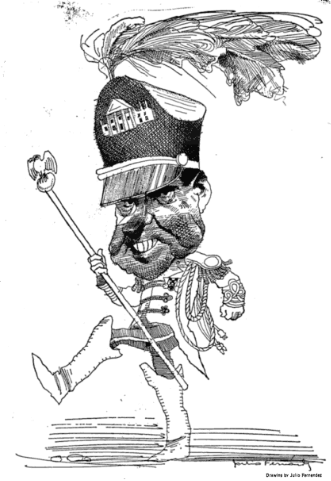
In his (in)famous 1952 “Checkers” speech (in response to accusations about a political slush fund) Richard Nixon, fighting to remain on the Republican ticket as candidate for the vice-presidency, poor-mouthed that his wife didn’t wear a mink coat but “a respectable Republican cloth coat.” While Pat Nixon shivered through a few winters without a fur wrapping, Dick was apparently always thinking about fashion. For, when he became president in 1969, he decided that the White House police needed a new kit: a “white‐tunicked, gold‐braided, pillbox‐hatted ceremonial uniform.” (1)


If Nixon was concerned about outfitting those around him, his Supreme Court appointee William Rehnquist was concerned about his own threads. He eventually decided that his sitting on the bench as Chief Justice (after nomination by Ronald Reagan) called for new robing. Here’s the report in the New York Times:
Chief Justice William H. Rehnquist appeared on the bench in a black robe adorned with four gold stripes on each sleeve. The courtroom audience was too polite to point or exclaim, but an explanation was clearly in order and, within hours, the Court's public information office provided one: the Chief Justice had designed a robe after one worn by the Lord Chancellor in a local production of Gilbert and Sullivan's "Iolanthe," and he intended to keep on wearing it. (2)
Gilbert and Sullivan, perhaps, instead of The Student Prince to the Times’ eyes, but to mine, those stripes on the robe reminded me of nothing other than the length-of-service stripes on the ancient waiters at the Gage and Tollner restaurant in downtown Brooklyn. (3)

*

Having offered advice for gifting Republican fashionistas, we can turn our thoughts (in our not-quite-Martha-Stewart way) to jollying-up GOP office decor. 

We can start with a custom hardwood table, chairs, and a hutch for 31,561 taxpayer dollars for that bargain shopper Ben Carson, the secretary of housing and urban development. But for a mega-list of gift ideas we had best turn to recently-resigned (but not lamented) Scott Pruitt, former administrator of the Environmental Protection Agency. 
[Pruitt] installed a $43,000 soundproof phone booth in his office that the Government Accountability Office has deemed violates federal spending laws.Another $9,000 was spent sweeping Pruitt’s office for listening bugs and installing biometric locks. Pruitt’s head of security wanted to spend another $70,000 to replace two desks. A total of $1,560 was billed to the EPA for 12 customized silver pens. (4)
*

Hopefully, this post has eased the burden of your GOP gift selection anxieties. If you somehow forget these particular items, you can’t go wrong by adhering to the following advice: 

Make sure it’s costly, unnecessary, tasteless, and paid for by other people.

***

(1) To the Washington Star the men looked like West German traffic policemen: “One's first inclination ... is to ask, ‘Wo ist der Bahnhof?’” (“Where is the railroad station?”) The Cleveland Plain Dealer thought they looked more like “generals in the banana republics to the south of us.” To the Chicago Daily News they were like movie characters in “a rerun of ‘Graustark’ or ‘The Student Prince,’” the Detroit News found them “unusual but ghastly,” while the Buffalo Evening News said “even ushers at old‐time movie palaces were garbed with greater restraint and better taste.” “Ruritania, D.C.,” scoffed The New York Times. 


(3) For decades Brooklyn’s finest would be served she-crab soup, Baltimore broiled clams, English mutton chops and kidneys en brochette by waiters in gold striped uniforms that indicated their length of service, with the Gold Eagle the most prestigious award, signifying 25 years of service.


Thursday, December 13, 2018

Polls, Taxed

“Raise your hands, all in favor of declaring that gay people are no longer afflicted with a mental illness.”

Well, it wasn’t done as starkly as that, but as Andrew Scull points out, the declaration “that homosexuality, previously labeled a mental illness, was nothing of the sort” was decided “by a majority vote of America’s psychiatrists,” and thus the second edition of the bible of the profession, the Diagnostic and Statistical Manual of the American Psychiatric Association (DSM), published in 1968, eliminated that diagnosis. It was, Scull writes, “surely an odd way to decide a scientific question, though, to be sure, one that all but the most bigoted would eventually endorse as appropriate.” (1)

*  

A few years before that change in the mental health field, a massive headache afflicted a good number of editors and writers upon first gazing into Webster's Third New International Dictionary, Unabridged, published in 1961 by Merriam-Webster. Those folk were appalled because, as they saw it, the new dictionary left the vast public of English speakers up the language creek without a prescriptive paddle.

To the rescue came a new dictionary, the American Heritage Dictionary. What was special about the AHD was that its parent company gathered together a panel of 105 literati and others to advise “with regard to dubious or controversial locutions.” (2) The voting by the panelists on questions of English usage was, to paraphrase Scull, surely an odd way to decide language questions, the answers to which are not determinable by democratic shows of hands. And what do you do when you have a tug of war over the use of the split infinitive—with half the panel on each side of the rope?

*

I remember, in that general period of time, that one year when Downbeat, the jazz magazine, was conducting its annual awards poll, one of the magazine’s writers refused to participate in selecting a best trumpeter or best pianist (and the rest), because, he claimed, art is not to be judged like a beauty contest or sporting event. (3) Of course, no one in any artistic field pays any attention to such an argument. So the public is offered a steady diet of meta-lists, as “experts” in the theater and music (and so on) are polled to anoint the BEST actor of all time (Judi Dench, as I recall) or the BEST pianist (Rachmaninov, wasn’t it?) 

While one doesn’t expect that the next show of hands by American psychiatrists will decide that gays really are neurotic or psychotic (or whatever), artistic polls (being totally subjective) are quite quixotic. Consider the movies (or should I say “cinema” in this context?): For gazillion years the BEST movie of all time was proclaimed to be “Citizen Kane”; then, out of the blue, in 2016, “Vertigo,” Alfred Hitchcock’s neutron bomb (4) of a movie, topped Sight & Sound’s 10-yearly poll. (5) 

How is it, I wonder, that when nothing had changed in ten years (“Vertigo” did not pitch 5 no-hitters, during which time “Citizen Kane” suffered through several prolonged batting slumps) that the former film could leapfrog over the latter? 

All who proclaim “Total Bollocks” raise your hand.

As for me, I have more faith in magazine polls that list New Jersey’s best dentists.   

***


(3) I don’t recall which writer it was (perhaps Leonard Feather), and, even more regretfully, I don’t recall his exact argument. So, I offer the assumed explanation above with fingers crossed that I came close to his argument.

(4) “A weapon that killed [people] by irradiation while sparing property.”
I fully expect to discuss “Vertigo” in a future post, but today’s my birthday, and I don’t want to have to deal further right now with that dud of a film.


Monday, November 12, 2018

Raindrops Falling on His Head

The news this weekend was interesting. The President of the United States finked out of a once-in-a-hundred-year commemoration of the end of the War To End All Wars (which, of course, didn’t). The official excuse for his not showing up at the Aisne-Marne American Cemetery in Belleau, France was that his 50-mile trip was “canceled due to scheduling and logistical difficulties caused by the weather.”(1) The weather (rain) supposedly made the ceiling too low for a flight by helicopter. Sarah Hockey Puck Sanders, White House Press Secretary, produced a photograph of the climatic conditions for the assembled press corps (minus CNN's Jim Acosta, naturally):


When questioned by incredulous newsmen, she denied the photo was “doctored.” 

The ceremony was attended by Chief of Staff John Kelly, who traveled by automobile. The White House later issued a statement that the President himself couldn’t go by car because of a fear of causing a traffic jam.(2)


Cynics immediately responded by claiming that while rain was indeed the issue, it wasn’t about helicopter altitude, but about hair altitude—that Trump was afraid that this:


would end up looking like this:(3)


Safe from the rain, Trump apparently stayed high and dry in his hotel room, where he could focus on the greatest mobilized threat a president has faced since the Battle of the Bulge—THE CARAVAN:


That is, the refugees from violence, hunger, and economic despair filtering through Central America toward the southern border of the US. But who were, according to Trump, infiltrated by shady Middle Easterners:


In his hotel room Trump presumably was fashioning orders for the mobilization of crack army troops to secure the border:


The greatest beneficiary of Trump’s troop movements would be his firmest political base—the white evangelical Christian bloc—here seen praying against Shakespeare(4): 


What these evangelical Christians would gain from the barring of the Latin American asylum seekers would be never having to mix in their congregations with a bunch of Latinos named Jesus.

***

(1) https://www.cnbc.com/2018/11/10/trump-cancels-ww1-memorial-at-us-cemetery-in-france-due-to-rain-sparking-twitterstorm.html


(4) https://wlos.com/news/local/concerned-mitchell-residents-hold-meeting-over-concerns-with-play-shown-to-students


Thursday, November 8, 2018

“I’m hungry; may I have a piece of bread?”

Friday is the 80th anniversary of Kristallnacht – the Night of Broken Glass. The pogrom of 9 November 1938 in Nazi Germany demonstrated to the Jewish population their lives were in urgent danger and that they must leave if they could. But where to go?(1)
One answer—if not for the escape of the parents—was for the children to be sent out of the Reich on what became known as the Kindertransport. The United Kingdom accepted 10,000 evacuees.(2) 

Another 669 children from Czechoslovakia were rescued singlehandedly by the remarkable English stockbroker Nicholas Winton:
[H]e made lists of the children, took their photographs, got them Home Office entry permits, found them foster families and organised their departure on trains, via the Netherlands, to Liverpool Street. After just three weeks in Prague, he went back to Britain and carried on the work from there.(3)
He was knighted by Queen Elizabeth in 2003, but he never considered himself a hero.

 *

But an even larger evacuation of children in the twentieth century took place from a land I (and, most likely, you) would never have guessed—Finland. 
During World War II, the Finnish government evacuated about 70,000 children to protect them from the danger, stress and uncertainty of war. Their parents agreed to send them to foster homes primarily in Sweden.(4)
The program may have spared those children the dangers of war, but there were apparently long-term costs due to their separation from their parents. Indeed, as Moises Velasquez-Manoff, the author of the Times article notes, “[Y]ears later, some would consider the program a grave mistake.”

Studies conducted some four decades after the children returned home discovered both psychological and health differences between those children and a control group who were not evacuated. Among the findings:
Men evacuated as children, Finnish scientists found, were more likely to have mental health and substance abuse problems than men who weren’t. Both sexes were more likely to suffer from depression if separated. . . .Illness and death from heart disease were more common in the separated group. They had about twice the risk of heart disease and a 40 percent increased risk of Type 2 diabetes. They had slightly higher blood pressure — particularly women.
*

Why bring all this up now? 

Because, as Velasquez-Manoff points out,
This research, which is ongoing, helps us understand the long-term consequences of another mass separation of children from their parents — the one orchestrated by the Trump administration.
More than 2,500 migrant children were taken from their parents and detained. Most have since been reunited, but 12,800 migrant children — a record, as we learned last week [i.e., in September]— remain in detention.
And his conclusion is damning:
The Trump administration probably intended the separation of children from their parents to be cruel. Conceived as a deterrent, it was meant to hurt. But was it supposed to impair cognitive development and cause heart attacks, diabetes and mental illness decades later? This may be its more sinister legacy: a subtle but lifelong derangement of mind and body.

*

Stephen Moss, the author of the Guardian article, tells of two Kindertransport children, now a married couple in their nineties, who go
into schools to talk to young people about what they and their parents suffered, testifying both as an act of remembrance towards their parents but also as a warning to the next generation that intolerance, hatred and scapegoating of minorities are ever-present threats.
While we keep learning about the consequences of warfare that extend beyond the piles of the slaughtered (both military and civilian) and the daily agonies of the wounded and the maimed, perhaps the testimony of these survivors can prevent peacetime from producing its own evils.

***


(2) The Guardian is telling the story of six of those children (see above footnote). 


Note: The title of this essay comes from another of Stephen Moss' articles on the Kindertransport children:
https://www.theguardian.com/world/2018/nov/07/the-kindertransport-children-80-years-on-im-grateful-my-parents-sent-me-away-to-carry-on-living